


Beoefenaars gebruiken moxa op meridiaanpunten met de bedoeling om de bloedsomloop door de punten te stimuleren en een vloeiendere bloedstroom en qi te induceren.
Er wordt beweerd dat moxibustion verzacht tegen koude en vocht in het lichaam en effectief is bij de behandeling van chronische problemen, “gebrekkige aandoeningen” (zwakte) en gerontologie.
Moxa kan nieuwe energie aan het lichaam toevoegen en kan zowel overmatige als gebrekkige omstandigheden behandelen.
Men kan acupunctuurnaalden gebruiken in combinatie met moxa, afhankelijk van de richting van qi-flow die ze willen stimuleren.
Er zijn verschillende methoden van moxibustion. Drie daarvan zijn directe littekens, directe niet-littekens en indirecte moxibustie.
- Directe littekenvorming : men plaatst een kleine conus van moxa op de huid op een acupunctuurpunt en verbrandt deze tot de huid blaren, die vervolgens littekens na genezing.
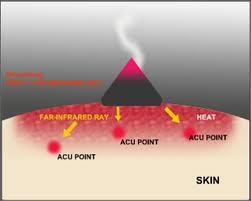
- Directe niet-littekens makende moxibustie : men verwijdert de brandende moxa voordat de huid verbrandt tot een litteken.
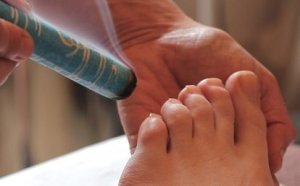
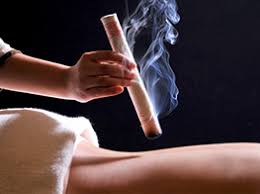
- Indirecte moxibustie: men houdt een sigaar gemaakt van moxa nabij het acupunctuurpunt om de huid te verwarmen, of houdt deze vast op een acupunctuurnaald die in de huid is ingebracht om de naald te verwarmen. Er is ook stick-on moxa.
****************
Les praticiens utilisent le moxa sur les points méridiens avec l’intention de stimuler la circulation à travers les points et d’induire un flux sanguin et qi plus fluide .
On prétend que la moxibustion adoucit le froid et les liquides dans le corps et qu’elle est efficace dans le traitement des problèmes chroniques, des «troubles déficients» (faiblesse) et de la gérontologie.
Le moxa peut ajouter une nouvelle énergie au corps et peut traiter des conditions excessives et inadéquates.
Les aiguilles d’acupuncture peuvent être utilisées en combinaison avec du moxa, en fonction de la direction du qi-flux qu’elles veulent stimuler.
Il existe différentes méthodes de moxibustion. Trois d’entre eux sont des cicatrices directes, des non-cicatrices directes et une moxibustion indirecte.
- La cicatrisation directe: un petit cône de moxa est placé sur la peau à un point d’acupuncture et brûlé sur les cloques de la peau, qui deviennent alors cicatrices après la guérison.
- Moxibustion non cicatricielle immédiate: on enlève le moxa brûlant avant que la peau ne brûle à une cicatrice.
- Moxibustion indirecte: on garde un cigare en moxa près du point d’acupuncture pour chauffer la peau, ou on la tient sur une aiguille d’acupuncture insérée dans la peau pour réchauffer l’aiguille. Il y a aussi du moxa adhésif.
****************
Practitioners use moxa on meridian points with the intention to stimulate circulation through the points and induce smoother blood flow and qi.
It is claimed that moxibustion softens cold and fluid in the body and is effective in the treatment of chronic problems, “deficient disorders” (weakness) and gerontology.
Moxa can add new energy to the body and can treat both excessive and inadequate conditions.
Acupuncture needles can be used in combination with moxa, depending on the direction of qi-flow they want to stimulate.
There are different methods of moxibustion. Three of them are direct scars, direct non-scars and indirect moxibustion.
- Direct scar formation: a small cone of moxa is placed on the skin at an acupuncture point and burned to the skin blisters, which then become scarring after healing.
- Immediate non-scarring moxibustion: one removes the burning moxa before the skin burns to a scar.
- Indirect moxibustion: one keeps a cigar made of moxa near the acupuncture point to heat the skin, or holds it on an acupuncture needle inserted into the skin to heat the needle. There is also stick-on moxa.
 So's Chinese Medicine /Traditionele Chinese geneeskunde/acupunctuur in Wemmel (Brussel)